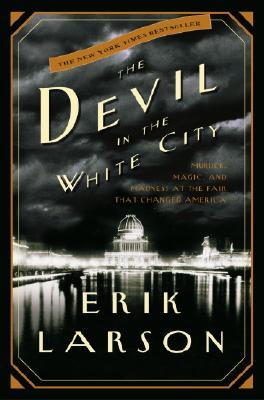
As I mentioned before, I’m participating in the Nonfiction Book Club at Doing Dewey Decimal. This month we are discussing The Devil In The White City by Erik Larson. I’ve already read it twice — the second time for my local book club — so I am just skimming this time and not necessarily getting the same experience everyone else is. Just the same, I am going to answer the questions based on my memory and very brief skimming. Below are my answers to the first part of the discussion. Visit the Doing Dewey Decimal blog to see links to other responses.
Have you read this or anything else by Erik Larson before? If so, how does this read compare to your first read through/his other books?
As I mentioned above, I have read this one twice already. Just skimming is not giving me the same experience, as I am not wondering what will happen. The second time through was different than the first. Since I already knew what would happen, I felt like I read for detail more. I particularly remember paying more attention to the details of the architecture and technical aspects of construction. I’ve not read anything else by this author, but there are a couple of books on my list. I really want to read Dead Wake, the story of the Lusitania.
How do you feel about the authors of nonfiction filling in the blanks left by sources and/or speculating about emotions?
I have mixed feelings about this. On the one hand, I think in some ways it is necessary. To not fill in the blanks or to write without emotions would make this a very dry history and not nearly as interesting. It would be much harder to get through if it were just a recitation of facts. But on the other hand, there were several times, particularly when reading of a person’s thoughts and emotions, that I silently questioned the author — “How do you know that??” I do appreciate that the author clearly stated that anything in quotes came from a source, a diary or newspaper article, etc. But I also understand that memories vary and people misstate the facts for various reasons, so even though this is a narrative history, I was aware that many times it was an opinion and not necessarily a fact.
If there was another World’s Fair in Chicago next year, would you go?
I honestly can’t say whether I would go. Chicago is only about a 4-hour train ride from me and I have friends and relatives up there, so it is much more likely I would go to a fair there than many other places in the country. Also, I do like to visit Chicago — there is so much to see and do there. But I’m not sure I’d be willing to pay a lot of money to get in, so it may depend on pricing and what there was to see. I don’t think seeing a World’s Fair holds the excitement it did 100 years ago for many reasons, not the least of which is that people actually travel to different parts of the world much more easily and frequently than they could possibly have imagined at the turn of the last century! Also, we have the internet and can visit and learn about other cultures virtually. Technology is in many ways taken for granted today. It’s hard to imagine what could be developed that would impress us today in the way that electric lights and ferris wheels impressed people at the turn of the century!
Is it appropriate to treat reading about a real serial killer as entertainment? Is it any different than if this story were fictional?
I don’t know if it is appropriate or not. I don’t really feel like I am reading it as entertainment, as I am aware the whole time that it is real. And really, I’m not sure it is different than reading about any terrible event. I don’t think we are making the serial killer into a hero, but in fact, he comes off very badly. I guess it is different because these characters really lived and died, as opposed to being fictional characters, but I don’t feel like we are exploiting anyone so this really doesn’t bother me.
Have you been or would you like to be part of a group creative endeavor, such as that undertaken by the architects at the World Fair?
I’m not a creative type so I don’t think I would unless it was as part of a group. However, as I read this, I didn’t really see it as a creative endeavor. To me, it felt more like a technological challenge to be solved, using science and math. That is probably a team I’d enjoy being part of.
There are my thoughts! It’s not too late to jump in with your own thoughts. Just grab a copy of the book and visit the sign-up page.