Showing posts with label discussion. Show all posts

Friday, April 15, 2016

#NFBookClub - The Reason I Jump Discussion 1


This month the Nonfiction Book Club at Doing Dewey is reading The Reason I Jump by Naoki Higashida. Here is a quick synopsis from Goodreads.

You’ve never read a book like The Reason I Jump. Written by Naoki Higashida, a very smart, very self-aware, and very charming thirteen-year-old boy with autism, it is a one-of-a-kind memoir that demonstrates how an autistic mind thinks, feels, perceives, and responds in ways few of us can imagine. Parents and family members who never thought they could get inside the head of their autistic loved one at last have a way to break through to the curious, subtle, and complex life within.
Using an alphabet grid to painstakingly construct words, sentences, and thoughts that he is unable to speak out loud, Naoki answers even the most delicate questions that people want to know. Questions such as: “Why do people with autism talk so loudly and weirdly?” “Why do you line up your toy cars and blocks?” “Why don’t you make eye contact when you’re talking?” and “What’s the reason you jump?” (Naoki’s answer: “When I’m jumping, it’s as if my feelings are going upward to the sky.”) With disarming honesty and a generous heart, Naoki shares his unique point of view on not only autism but life itself. His insights—into the mystery of words, the wonders of laughter, and the elusiveness of memory—are so startling, so strange, and so powerful that you will never look at the world the same way again.
In his introduction, bestselling novelist David Mitchell writes that Naoki’s words allowed him to feel, for the first time, as if his own autistic child was explaining what was happening in his mind. “It is no exaggeration to say that The Reason I Jumpallowed me to round a corner in our relationship.” This translation was a labor of love by David and his wife, KA Yoshida, so they’d be able to share that feeling with friends, the wider autism community, and beyond. Naoki’s book, in its beauty, truthfulness, and simplicity, is a gift to be shared.

This is a really short book so there is still plenty of time for you to jump in and discuss it with us. Read more on Katie’s blog here. Katie is also hosting discussions on the book, Here are the first set of questions, along with my answers.

Is the tone of the book what you expected, from someone with autism and/or from a thirteen year old boy?

I’m not sure I had any expectations. He does seem perceptive, and at the same time he seems a bit — I’m not quite sure how to word it, so I will say ‘self-centered’ but I don’t think that is exactly what I mean. He seems to feel his experiences are universal to all who have autism, and I’m not sure that is true. At times I had to remind myself that he is only thirteen years old.

Have you learned anything that has surprised you so far?

I’m not sure I am surprised by anything because I had no expectations. But I am a little saddened by how often Naoki expresses that he ‘hates’ himself because of mistakes he makes or because he makes others unhappy or uncomfortable.

Do you think that you would interact with someone who has autism differently after reading this book?

Probably not. I understand better what that person might be feeling or thinking, but sadly, I am not a very outgoing person. I’m not sure understanding would make me more outgoing and able to set the other person at ease. (I sometimes wonder if I am on the autism spectrum somewhere.)

David Mitchell says that the problems of socialization and communication people with autism display “are not symptoms of autism but consequences.” What does he mean exactly...what is the difference as Mitchell sees it? (source)

I do understand what he is saying about communication being locked up inside the person, even though they understand very well what is being said and are aware of their surroundings. As I read the early part of the book, I thought how much it reminds me of Alzheimer’s patients and other patients with communication problems who become so frustrated because they know exactly what they want to say, but are unable to communicate this information. The inability to communicate is a result of their disease; but it is also a symptom.

That’s it for now. You can read Katie’s answers here and share your own. And look for the second set of questions coming later this month!

post signature

Monday, March 28, 2016

#NFBookClub: Missoula Discussion #2


This month Nonfiction Book Club, hosted by Katie at Doing Dewey, has been reading Missoula by Jon Krakauer, and it’s time for Discussion #2. Here are the questions from Katie, along with my answers.

Did you finish the book feeling as though there was action you could take?

Not really. I guess I can be sympathetic to a woman who identifies herself as a rape victim, but unless someone comes forward and talks to me about it, I won’t know. I’d also like to think I would be just as sympathetic whether or not I’ve read this book. I think one thing that needs to change is the ‘stigma’ of rape left over from a century ago when a girl was ‘ruined’ by rape and the ‘no man would ever want her now’ mentality, however, I don't really feel that there is any action that I can take that would make a difference.

Did this book change your perception of any aspect of rape cases?

I’m not sure, because I’m not sure I ever gave it a lot of thought previously. I am probably more aware of how vulnerable young women can be — and how naive. I guess I’m also more aware of how big a difference education could make; for young men to understand recognize what rape is, for young women to understand and recognize when they are putting themselves in a dangerous situation, and for both young men and young women to recognize the large role alcohol apparently plays in many of these situations.

Did you enjoy this and/or would you recommend this to someone else?

I don’t think ‘enjoy’ is a word I would use to describe my experience with this book. I can say that it wasn’t as difficult a read as I expected. I think I expected the writing to be a bit dry and heavy on facts, but was a much more personal telling. And while nothing here was pleasant, it wasn’t as bad as I’d set myself up for. I’m not sure I’d recommend this to anyone in particular; maybe if I knew a young woman headed of the college, or the parent of a young woman headed off to college, I’d recommend it as a read to make her aware of how quickly things can go bad so that she won’t head off as naive and unprepared as these women were. I hope this doesn’t come off as ‘blaming the victim’ because that is not what I want to do. It may not be fair that she has to take precautions to avoid being raped, but to me it is kind of not driving through a ‘bad neighborhood’ if you don’t have to.

Do you have any new thoughts on the topics of the questions from the first half of the book, particularly the value of this book and the author’s possible biases?

I don’t think my views have changed much. I sensed that the author was biased before, and he confirmed that at the end of the book. At least I understand WHY he presented such a one-sided view now. I guess I just wish he would have given a little balance to the book by including stories young men being victimized when the couple each interpreted the situation differently, or because the woman outright lied. If you are going to improve the way these cases are handled, you have to consider all possibilities to find a way to uncover the truth. Of course, the book did a great job of showing us that getting at the truth is not what our legal system is about. And I can understand that the author was focused on exposing the injustice in the system at a specific place and time, so confined himself to cases in Missoula.


Have you been participating in the Read-Along this month? What did you think of the book? You can see my discussion one answers here. Be sure to visit the discussion page on Katie’s blog to check-in with your answers and to learn what other readers think of the book!

post signature

Sunday, March 13, 2016

#NFBookClub: Missoula Discussion #1


It’s check-in time for the Nonfiction Book Club at Doing Dewey, This month we are reading Missoula by Jon Krakauer and the first discussion is posted. Here are the questions from Katie, along with my answers.

What do think of the author’s tone? Does he come across as an unbiased reporter and should he?
To be honest, he does not come across as totally unbiased, and yes, to have credibility he does as least need to appear unbiased. It seems to me that he may be cherry-picking the most obvious, clear-cut cases so that there is no doubt these men are guilty. Rape is a horrible crime, but I don’t think it does any good to ignore the fact that sometimes men are falsely accused and sometimes there really are differing perceptions about what happened when. It also bothers me a little that at times the questions asked by the police and their slow, methodical gathering of evidence is criticized by him. No matter how horrible the crime, we still need to go with ‘innocent until proven guilty’.

So far, do you think this is a worthwhile read? Do you feel it serves a purpose?
I’m on the fence right now. I think I need to see where this ends up before I decide if it is worthwhile. There is a lot of criticism of the system so far, but I’m wondering if there are any concrete suggestions on how to make thing better when I finish the book. If not, I may feel like the book is sensationalism.
Are there any facts that have particularly surprised you or that you think other people should be aware of?
I guess I’m a little surprised by the fact that some of these men, Frank in particular, did not seem to understand that what he was doing was considered rape and was NOT OK! And particularly how predatory he and his fraternity friends were. This was a learned behavior! One of the local school districts near here just revised their sex ed curriculum — not without some controversy — and one of the bigger changes is that they will now be teaching 8th-graders and 10th-graders about sexual consent. It’s sad that is necessary, but after reading about Frank, it’s obvious that the discussion is needed.
How are you liking the book so far?
I am actually, and that surprises me. I think I expected it to be a difficult topic to read about and to be a dry read full of statistics. It IS difficult at times, but the story flows very well, and it is very readable. Even though at times I feel the author is manipulating me, and having the conversation HE wants to have, I am not sorry we picked this one up.

There are my answers. I wonder if they will change any as I read further into the book.
Are you participating in the Read-Along? How do your answers compare with mine? Be sure to visit the discussion page on Katie’s blog to learn what other readers think of the book!

post signature

Tuesday, February 23, 2016

#NFBookClub: Headstrong Discussion #2


This month I have been reading Headstrong by Rachel Swaby for the Nonfiction Book Club hosted by Katie at Doing Dewey. The month is almost over and I’ve finished the book so, it’s time for Discussion #2. Here are the questions from Katie, along with my answers.

Did you learn anything that especially surprised you?

This is such an open-ended question and hard to answer because there were so many interesting things happening. One thing I learned is that in general, the Nobel Prize is only awarded to living people. I hadn’t realized that until I read this book. Another thing that really struck me was how many of these women (and men) were Jewish and threatened by the events of WWII, to the point that they had to abandon their work and pick it up again elsewhere. It made me wonder how much more they could have accomplished had they been able to work without the distractions of war and relocation.

If you had to go to work in one of the scientific fields described in the book, which one would you choose and why?

This is another one that is a little tricky for me to answer. When I was very young, I used to play ‘astronaut’ and dream about space travel. Even now, I love looking at the night sky. Ironically, I ended up on the life sciences side, using my biochemistry and microbiology while working as a research biologist. Reading about these women made me realize how much I miss working in the lab. However, if I were choosing today, I think I’d be drawn into computers and software development.

Inspired by a comment by Kim of Time 2 Read, I’m curious – How do you feel about Sally Ride’s recommendation that NASA focus their efforts more here on Earth?

Ha….I’m inspirational! Since I’ve already discussed this, I won’t go into it too much. I do feel that NASA should be on the cutting edge of exploration and discovery. That doesn’t mean that that I think solving problems on earth isn’t important;  I just don’t think that NASA is the organization to handle that. Just as Lewis and Clark explored the frontiers of the 19th century, which led to development by others, I think NASA should be expanding our boundaries, both in space and in knowledge, and not sitting back so we can play ‘catch-up’ later while other countries continue to explore space.

Are there any other books that you’d recommend for further reading on science history, especially female scientists?

One book I’ve had on my list for awhile is The Girls of Atomic City by Denise Kiernan, an account of the atomic bomb work done at Oak Ridge, Tennessee during the second world war. I just learned about another book today and it has caught my interest. The Mercury 13 by Martha Ackmann is the story of thirteen women who were chosen to train as astronauts in the early days of the space program, long before Sally Ride. It is an older book, published about ten years ago, but I’m hoping I can find a copy.

Have you been participating in the Read-Along this month? What did you think of the book? Be sure to visit the discussion page on Katie’s blog to check-in with your answers and to learn what other readers think of the book!

post signature

Thursday, February 11, 2016

#NFBookClub: Headstrong Discussion #1


I am participating in the Nonfiction Book Club hosted by Katie at Doing Dewey and this month we are reading Headstrong by Rachel Swaby. It’s time to discuss what I’ve read so far, scientists who found success in Medicine, Biology and Environment, and Genetics and Development. Here are the questions from Katie, along with my answers.


What did you think of the obit beginning with Brill’s domestic accomplishments?

My initial reaction was that I was a little upset with the author for being so negative; I felt that she devalued family. Many time celebreties point out that despite their many accomplishments, the most important one to them is their children, so I don’t think it is out of line to mention family first, no matter how famous one becomes. I think this is particularly true on an obituary page. However, I think I also need to look at context. I don’t know the context of this one, but if this was not published in Brill’s hometown newspaper, and we can assume the only reason her obituary was in the Times was BECAUSE she was an accomplished scientist, that accomplishment should have been mentioned near the beginning of the obituary. But I do think family needed to be mentioned. In a way, that makes her accomplishments even greater. So many times in this book I’ve read that the woman gives up the idea of marriage and family in order to devote her time to science. There is nothing wrong with that, of course. But it is nice to have examples for young women that show they can have a family life and still have a successful career.

How do you like the vignette style of this book?

I’ve really got mixed feeling about this. On the one hand it is very readable. I can pick it up even if I only have five minutes and read about one scientist. But on the other hand, I’m not really learning a lot about the scientist or the science. I kind of wish there was a little more detail on the science of the discovery. I also feel that this book may not really accomplish what it sets out to do, assuming the goal is to get these women recognition. I am reading about their accomplishments, but six months from now, I’m not sure how much I’ll remember. I’m pretty sure I won’t remember the names. It might have been better to write a longer book, or even a series of books covering the different topics and including more detail. But then again I would have been less tempted to pick up a 500 page book! Perhaps it’s enough just to be able to remember ‘a woman did this’!

Do you have a favorite story so far? If so, which one and why?

I forget!
Seriously, I’m enjoying a lot of these, particularly when I can make a connection of some sort. I particularly enjoyed reading the story of Alice Ball, the scientist who developed the chaulmoogra oil treatment for leprosy. I just recently read Moloka’i by Alan Brennert for the second time, so I was able to place her discoveries in context. Now I want to go read it for a third time to see if Alice gets a mention in the novel!

Do you think something should be done today about the many female scientists who are known not to have received the credit they were due in their time, from paper authorships to Nobel prizes?

That is a complicated question! I don’t think they should be awarded a Nobel prize, at least none of the women mentioned in this book, because Nobel prizes are not awarded posthumously. Beyond that, it is hard to say what kind of recognition they should get. Truthfully, male or female, there are very few scientists I could name and tell you what they did. I personally always got a little annoyed in my science classes when more emphasis was placed on who made a discovery than the discovery and its implications. I also think that there will always be scientists that don’t get the credit they deserve, or think they deserve. When new discoveries depend so much on what was known before, there are often disagreements over who did what when. So I don’t really think these women will ever get the credit they may deserve. But it might be nice if PBS did some sort of series on scientific discoveries and recognized these women and the contributions they made to science.

That’s it for now. Next we will be reading and discussing scientists who worked in Physics, Earth and Stars, Math and Technology, and Invention. Are you participating in the Read-Along? How do your answers compare with mine? Be sure to visit the discussion page on Katie’s blog to learn what other readers think of the book!
post signature

Saturday, November 28, 2015

Nonfiction November Week 4: Read-Along Discussion


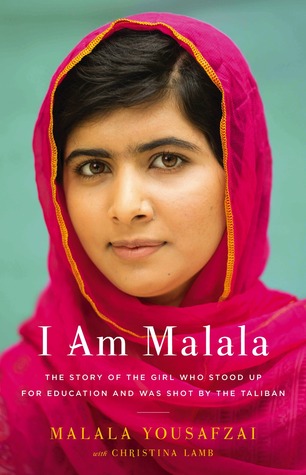
Week 4 of Nonfiction has come and almost gone….and I’m way behind with my post. I DID have a great Thanksgiving though. This week we’ll be wrapping up Nonfiction November with a discussion of our read-along book, I Am Malala by Malala Yousafzai and Christina Lamb. Discussion questions were posted Monday by Katie at Doing Dewey. Here are more responses.

1. What did you think of the tone and style in which I Am Malala was written?
I found the writing choppy at times. Sometimes she came off as a little immature; not entirely unexpected since she was still a child during the events of the book. But otehr times she seemed to be explaining events with the outlook of an adult and I almost felt as she was parroting words of another. I also felt like at times she was a little too willing to pat herself on the back as in ‘good job’. I almost hesitate to say this, but I do realize what she did is remarkable, however, at times the lack of humility was off-putting to me.

2. What did you think of the political commentary in the book?
I questioned it at times, wondering how much of it was really happening the way she stated. Again I had to wonder about the understanding of a child at the time many of these events took place. I felt either someone else had told her how to interpret the events of the world, or that perhaps she’d gone back and read — quite a bit — about the events that took place at that time. I’m not necessarily disagreeing with her viewpoint, and I’m not agreeing with it either, but I do have to wonder how much she knew about world events at that particular time, and whose thoughts were coloring her interpretation.

3. Did anything particularly surprise you about Malala’s daily life or culture?
I don’t think I was really terribly surprised. I’ve read quite a bit, both fiction and nonfiction, about the Pashtun culture and the culture women face. If anything, I guess I was surprised at how much freedom Malala seemed to have from the constraints of her culture. I’m sure that was because of her father’s willingness to support her instead of enforcing the cultural restraints.

4. Do you think you would act similarly to Malala in her situation? If you were her parents, would you let her continue to be an activist despite possible danger?
I’m really not sure what I’d do. I suspect I would be more cowardly and go with the flow. And perhaps, if I didn’t really know better, I may not even miss the freedoms of the modern world. However, having been exposed to the ‘real’ world, I’m sure I’d chafe and moan, but I don’t know if I’d be willing to risk my life. To be fair though, Malala states that she never felt she was risking her life, either. She expected her father might be attacked, but she didn’t not expect a child to be attacked. (I’m not sure why, because it didn’t surprise me!) As her parent, I am 100% sure I would do everything possible to keep my child safe, including leaving the area with her the first time trouble started. I would never EVER have come back!


5. What did you think of the book overall?
Though at times certain things in the book annoyed me, as I mentioned above, I’m glad I read the book. In some ways though, it felt more like a publisher decision to get a book out now. I kind of wish they would have waited a few years. I would have liked to have seen what happens to Malala as she matures into adulthood. Will she continue to speak out? Will she become more ‘western’ or will she return to her homeland? If she does, will she become the politician she dreams of becoming, and will she continue to try to change her world even though it puts her life in danger?
post signature